

Website Development Cost in India (2026): What You Will Actually Pay
By Webinfix Technologies Team · · Updated · 9 min read
A website in India costs anywhere from a few thousand rupees for a single landing page to several lakhs for a custom web application. The number depends on how many pages you need, whether you want to edit content yourself, and whether the site has logins, payments or a database.
This guide explains each tier in plain terms so you can judge a quote instead of guessing. It also covers the costs people forget (domain, hosting, maintenance) and the questions that separate a fair quote from a risky one.
Quick price ranges
These are the starting prices we publish at Webinfix Technologies. Your final quote depends on scope and is confirmed before work begins.
| Type of website | Starting price | Typical delivery |
|---|---|---|
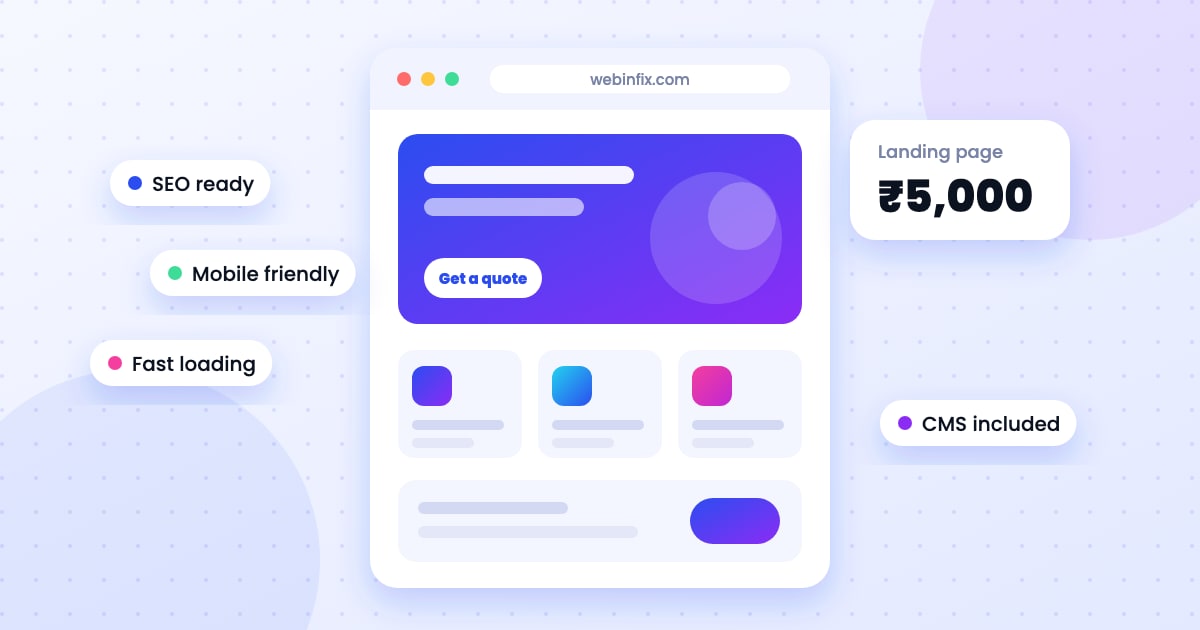
| Landing page (1 page) | ₹5,000 | about 7 days |
| Business website (up to 8 pages) | ₹12,000 | 2 to 3 weeks |
| CMS website (edit content yourself) | ₹22,000 | 3 to 5 weeks |
| Web app / SaaS | ₹45,000+ | depends on features |
Other agencies and freelancers price differently, and prices in metro cities are often higher than in smaller cities. Do not compare only the headline number. Compare what is included, which is what the rest of this guide helps you do.
What each plan actually includes
A price means little without the scope behind it. Here is what sits inside each of our tiers.
- Landing page: one responsive page, basic search setup, a contact form and one round of revisions. Built to collect enquiries, not to be a full company site.
- Business website: up to 8 pages, a simple content setup, Google Analytics, speed work, social links and two rounds of revisions.
- CMS website: unlimited pages, a custom admin panel, a blog or news module, team and portfolio sections, stronger search setup and a WhatsApp chat button.
- Web app / SaaS: a custom backend and API, user logins and roles, an admin dashboard, payments, database design and a month of support after launch.
When you compare quotes from anyone, ask for the same kind of list. A low price with a short list is not the same offer as a higher price with a long one.
What changes the price
Number of pages and custom design. A template-based site is faster and cheaper. A fully custom design needs more design time, and it shows in the result.
A CMS (content management system). If you want to add blog posts, products or team members without calling a developer, the site needs an admin panel. That is the main reason a CMS site costs more than a brochure site.
Logins, payments and dashboards. The moment users need accounts, a payment gateway or a dashboard, you are building an application, not a website. Backend work, database design and testing are what push the price up.
Integrations. WhatsApp chat, Google Analytics, CRMs, email tools and payment providers each add some setup time.
Content. Someone has to write the text and prepare the photos. If you provide ready content, the project moves faster. If the agency writes it, expect it to be priced separately.
Speed and SEO work. A site that loads fast and is set up for search takes deliberate effort. It is cheaper to build this in from day one than to fix it later.
WordPress, a website builder, or custom code?
The technology behind the site changes both the price and what you can do later.
- Website builders (Wix, Squarespace and similar) are quick and cheap to start. You pay monthly, you are limited to their templates, and moving away later means rebuilding.
- WordPress suits content-heavy sites. It has a large ecosystem of themes and plugins, but it needs regular updates and careful security, and a pile of plugins can slow the site down.
- Custom code (for example Next.js or React) gives you speed, full control over design and room to grow into an application. It usually costs more at the start and needs a developer for changes unless a CMS is added on top.
For a small business that mainly needs to look credible and collect enquiries, a clean, fast, simple build is usually the right choice. Pick the technology that fits your next two years, not the one that sounds most impressive.
Which one do you need?
- You are just starting and need something credible to share: a landing page is enough. It collects enquiries and tells people who you are.
- You run a service business and need pages for services, about, pricing and contact: a business website.
- You will publish regularly (blog, news, products, portfolio) or want a team to edit content: a CMS website.
- Your product is the website (bookings, dashboards, subscriptions): a web app.
You can also start small and grow. A landing page today can become a business website later, as long as the first build is clean and you own the code and domain.
What a good quote should contain
A useful quote is specific. Before you say yes, check that it states:
- The exact pages or screens included, not just "a 5-page website".
- Whether the design is custom or from a template.
- How many rounds of revisions are included, and what an extra round costs.
- The delivery time, and what you need to provide (content, logo, photos) to hit it.
- What is included after launch: bug fixes, support period, training.
- What is not included, such as copywriting, stock photos, paid plugins or a premium domain.
- How payment is split. A staged schedule tied to milestones is safer than paying everything upfront.
If a quote is one line with a single number, ask for the details. A good agency will not mind.
Hidden costs to ask about
Ask every agency or freelancer these questions before you pay:
- Is hosting included, and what does it cost after the first year?
- Who owns the code and the domain? It should be you.
- How many revision rounds are included?
- Is the site mobile-friendly and tested on real phones?
- What does support look like after launch?
The domain name usually costs ₹500 to ₹1,500 per year, and hosting varies by the platform. A good agency tells you these numbers up front.
Running costs after launch
A website is not a one-time purchase. Plan for these yearly or monthly costs:
- Domain renewal, every year.
- Hosting, which depends on the platform and traffic. Many small sites run on modern hosting at low cost.
- Maintenance and updates, especially for WordPress sites, which need regular security updates.
- Content updates, either by you (with a CMS) or by a developer.
- Optional extras, such as email accounts, a paid analytics tool or a booking plugin.
Ask for these in writing before the project starts, so there are no surprises in month three.
Common mistakes when budgeting for a website
- Choosing only the cheapest quote. The saving often disappears in fixes, delays and a site that does not bring enquiries.
- Not defining the scope. Vague scope leads to extra charges and arguments about what was promised.
- Skipping mobile. Most visitors arrive on phones. Ask to see the site on a real phone before you approve it.
- Forgetting content. A well-built site with weak text and no photos still looks unfinished.
- Not owning the assets. Make sure the domain, hosting account and source files are in your name.
Cheap, fast, good: you rarely get all three
A very low price usually means a reused template, no real testing, or no support afterwards. That is fine for a first landing page. For a site that must bring in business, spend on the parts customers notice: clear copy, speed, and a form or WhatsApp button that works.
If you want a number for your own project, you can see our pricing or send a short brief and we will reply with a clear scope and quote. You can also read our guide on how to choose a web development company in India before you shortlist anyone, or look at our website development service.
Frequently asked questions
How much does a simple website cost in India?
A single landing page starts around ₹5,000 with us. A multi-page business website starts around ₹12,000. Prices from other agencies vary, so compare what is included, not just the number.
Is a CMS website worth the extra cost?
Yes, if you will update content often. It lets you add pages, posts or products yourself instead of paying a developer for every change.
Do I need to pay yearly after the website is built?
You usually pay for the domain and hosting each year. Ask for these costs in writing before you start.
How long does it take to build a website?
A landing page takes about a week. A business website takes two to three weeks, and a CMS site or web app takes longer depending on the features.
Can I start with a landing page and upgrade later?
Yes. Many businesses begin with a landing page to collect enquiries and move to a business or CMS website once they have the content and budget. Make sure the first build is clean and that you own the code and domain, so the upgrade does not mean starting over.
Does a cheaper website hurt my Google ranking?
Price itself does not affect ranking, but what you get for the price does. A slow site, missing mobile support or poor page structure can hold back your search visibility. Ask what search setup is included and how fast the site loads on a phone.
What is the difference between website development charges and website design charges?
Design is how the site looks. Development is how it is built and how it works: pages, forms, the admin panel, integrations and speed. Most quotes bundle both, so confirm what your quote covers.
Should I pay everything upfront?
It is safer to pay in stages tied to milestones, such as design approval and launch. Ask for the payment schedule in writing before you start.
Keep reading
 Web3
What Is an IDO Launchpad? Features, Cost and How to Build One
An IDO launchpad lets crypto projects raise funds by selling tokens to investors. Learn how it works, the features it needs, security basics and what it costs.
 Websites
Website Development Pricing in India 2026: Complete Cost Breakdown
Discover the 2026 pricing landscape for website development in India. Get a clear cost breakdown, compare options, and learn what to ask before hiring.