

How to Build a DEX: Cost, Features and How a Decentralized Exchange Works
By Webinfix Technologies Team · · 3 min read
A decentralized exchange (DEX) lets people swap crypto tokens directly from their own wallets, with no company holding their funds. Smart contracts on a blockchain do the matching and settlement.
If you are planning to launch your own, this guide covers how a DEX works, the features it needs, and what a build costs.
How a DEX works
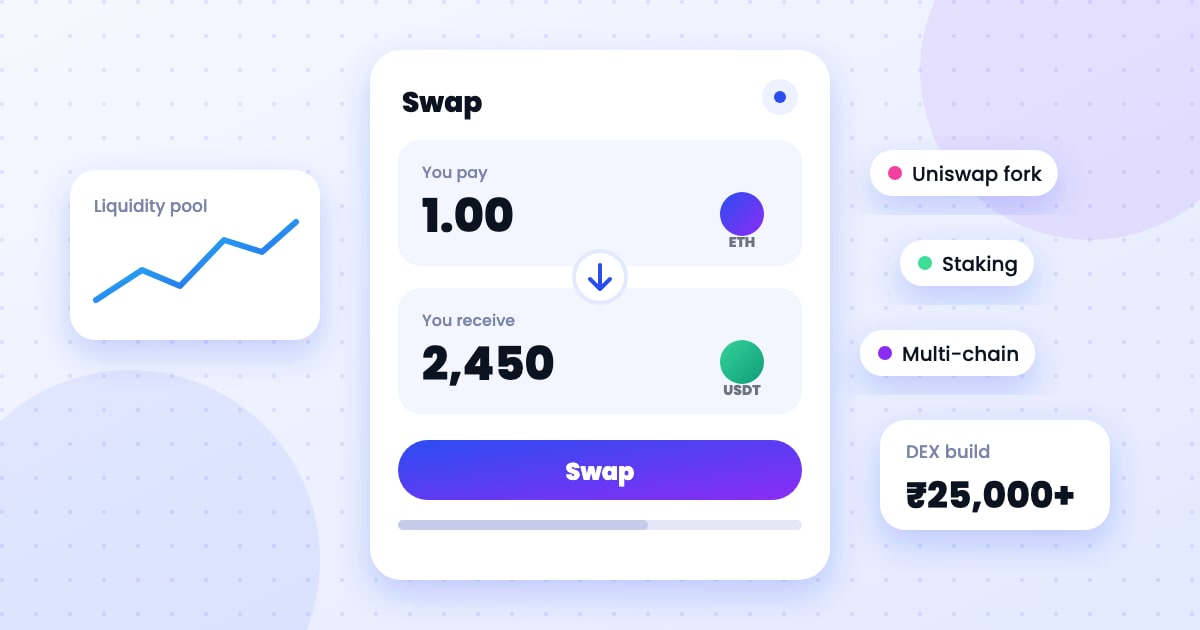
Most DEXs use an automated market maker (AMM). Instead of an order book with buyers and sellers, the DEX holds liquidity pools: two tokens locked in a smart contract. A price formula adjusts as people trade against the pool.
- Liquidity providers deposit token pairs into pools and earn a share of trading fees.
- Traders swap one token for another against the pool.
- The smart contract enforces the rules, so there is no central operator who can move user funds.
Core features of a DEX
- Swap interface with price impact, slippage control and wallet connect.
- Liquidity pools where users add and remove liquidity.
- Token pair management to list and configure pairs.
- Price charts so traders can see activity.
- Staking or farming (optional) to reward liquidity providers or token holders.
- Multi-chain support (optional) if you want to run on more than one network.
Build from scratch or fork?
Many projects start from a proven open-source base such as Uniswap V2 or V3 and customise it: branding, fee structure, supported chains and extra modules. A fork shortens development and reduces risk because the core logic has been used widely. A fully custom protocol costs more and needs more testing.
What does a DEX cost?
Our DEX and swap builds start from ₹25,000+ and an IDO launchpad starts from ₹35,000+. The price grows with the number of features, chains and custom contracts. Costs outside development also matter:
- Smart contract audit. For anything that holds user funds, an independent audit is strongly recommended.
- Liquidity. A DEX is only useful if pools have liquidity. This is your capital, not a development cost.
- Legal and compliance. Rules differ by country. Take proper legal advice for your market.
Security is the real work
Smart contracts cannot be edited easily after deployment, and bugs can cost real money. Test on a testnet first, verify contracts on the block explorer, and plan for an audit before you deploy to mainnet.
Next step
If you want to build a DEX, a token or a launchpad, read about our Web3 and blockchain development work or send us a brief.
Frequently asked questions
How much does it cost to build a DEX?
Our DEX and swap builds start from ₹25,000+, and the final quote depends on features, chains and customisation. An audit and liquidity are separate costs.
What is the difference between a DEX and a centralized exchange?
On a DEX, users keep control of their funds in their own wallet and trade through smart contracts. On a centralized exchange, the company holds the funds and runs the order book.
Can you build a Uniswap-style fork?
Yes. We build Uniswap V2 and V3 style forks with your branding, fees and extra modules.
Do I need an audit?
If the contracts will hold user funds, an independent audit is strongly recommended before mainnet launch.
Keep reading
 Pricing guides
Website Development Cost in India (2026): What You Will Actually Pay
A plain breakdown of what a website costs in India in 2026: landing page, business site, CMS and web app, plus what changes the price.
 Pricing guides
Mobile App Development Cost in India: MVP, Startup App and Enterprise
How much does it cost to build a mobile app in India? Price ranges for an MVP, a startup app and an enterprise app, and why React Native saves money.