

How to Launch Your Own Crypto Token (ERC-20 / BEP-20): Step by Step
By Webinfix Technologies Team · · 3 min read
Launching a token means writing a smart contract that defines the token, deploying it to a blockchain, and then planning how people will get and use it. The technical part is small. The planning around it is what decides whether the token is useful.
Step 1: Decide what the token is for
Write one sentence: what does a holder get? Access, rewards, voting, a payment method? A token without a clear purpose is hard to explain and hard to sustain.
Step 2: Pick the blockchain
- Ethereum (ERC-20): the most established network, higher fees.
- BNB Smart Chain (BEP-20): lower fees, popular for new projects.
- Polygon and others: low cost, growing ecosystems.
Choose where your users already are, not just where fees are lowest.
Step 3: Design the tokenomics
Tokenomics is the plan for supply and distribution. Decide the total supply, how much goes to the team, to sale participants, to liquidity and to rewards, and whether tokens unlock over time (vesting). Publish it clearly. Unclear tokenomics is the first thing careful buyers question.
Step 4: Build the smart contract
The contract holds the rules: name, symbol, supply, transfers and any extra features such as burning or taxes. Use well-known, reviewed base contracts instead of writing everything from scratch. Keep the features you add to a minimum, because every extra line is extra risk.
Step 5: Test on a testnet
Deploy first to a test network where nothing real is at stake. Test transfers, edge cases and every special function. Fix issues here, not on mainnet.
Step 6: Deploy and verify
Deploy to mainnet and verify the contract on the block explorer (for example Etherscan). Verification publishes the source code so anyone can read it, which builds trust.
Step 7: Add liquidity and a front end
For people to trade the token, it needs a liquidity pool on a DEX. Many projects also need a website with wallet connect, a token page, and sometimes staking or a presale page.
What does it cost?
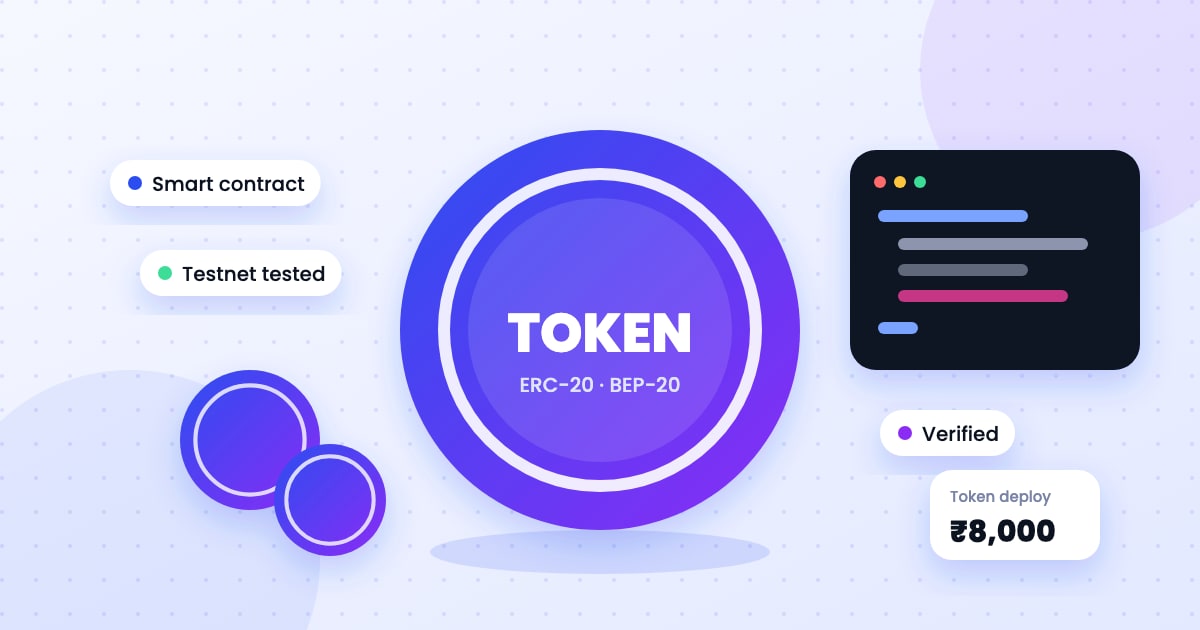
Our token deployment service starts from ₹8,000 and includes smart contract development, tokenomics setup, testnet and mainnet deployment, and a contract verified on the explorer. Network fees, liquidity and any audit are separate. See Web3 development for the full list.
Important notes
Rules around crypto differ by country and change over time. Take proper legal and tax advice for your situation. We build the technology and do not promise returns or price outcomes.
Frequently asked questions
What is the difference between ERC-20 and BEP-20?
Both are token standards. ERC-20 runs on Ethereum and BEP-20 on BNB Smart Chain. They work in a similar way, but fees and ecosystems differ.
How much does it cost to create a token?
Our token deployment starts from ₹8,000. Network fees, liquidity and any audit are extra.
Can I launch a token without coding?
Generators exist, but a custom contract gives you control over features and lets you review and verify the code. For a serious project, a developer-built contract is safer.
Do I need an audit for my token?
For simple tokens it is optional but recommended. For anything that holds other people's funds, such as staking or a launchpad, get an independent audit.
Keep reading
 Pricing guides
Website Development Cost in India (2026): What You Will Actually Pay
A plain breakdown of what a website costs in India in 2026: landing page, business site, CMS and web app, plus what changes the price.
 Pricing guides
Mobile App Development Cost in India: MVP, Startup App and Enterprise
How much does it cost to build a mobile app in India? Price ranges for an MVP, a startup app and an enterprise app, and why React Native saves money.